Crypto Industry Roundup: Binance Freezin...
2026-11-22


By the SecureShift Team · Updated November 10, 2026
Disclosure: SecureShift is a no-account swap service, so we're one of the options covered here. We've tried to be fair about the trade-offs. This is general information, not legal or financial advice.
People search for an "anonymous cryptocurrency exchange" for all sorts of reasons. Some are tired of uploading their passport to every new platform. Some have read about exchange data leaks and don't want their identity sitting in yet another database. Others simply think what they do with their own money is their business. All fair.
The honest truth, though, is that no exchange makes you fully anonymous. What the right service can do is cut down how much you share and who ends up holding it. This guide explains what "anonymous" really means in crypto today, the main types of services, and how to pick one without getting burned.
In practice, it usually means one of these:
A service can have all three and still see some things: your wallet addresses, the amounts, and your IP address like any website. And the blockchains themselves are public, apart from privacy coins like Monero. So think of it as "private by default, with limits", not invisible.
| Type | How it works | Pros | Cons |
|---|---|---|---|
| Instant swap services | Send coin A, receive coin B in your wallet. No account. | Fast, simple, huge coin choice | The service sees your order details. Some screen deposits for risk. |
| DEXs (decentralized exchanges) | Trade from your own wallet through smart contracts | No middleman holding funds | Usually one blockchain at a time. Every trade is public on-chain. Gas fees. |
| Atomic swaps | Two people swap coins directly using a cryptographic contract | Very private, no trusted party | Slow, technical, limited pairs and liquidity |
| P2P marketplaces | Trade directly with another person, often for cash or bank transfer | Can buy with fiat | Scam risk, slower, varying rules |
For most people who just want to move from one coin to another without an account, an instant swap service is the easiest route. If you're specifically after Monero, our comparison of atomic swaps vs instant swaps goes into more detail.
The upside of a minimal-data service is simple: if they never collect your passport, it can't leak. Exchanges holding millions of ID documents are an obvious target. That's a real reason many people prefer no-account services.
SecureShift is an instant swap service. Here's what you get, and what you don't:
To be clear about the limits: like every legitimate swap service, we have an AML policy. Unusual or high-risk activity, such as deposits linked to stolen funds, can be held for review. That's not something we hide, and you should be wary of any service that claims it will never check anything.
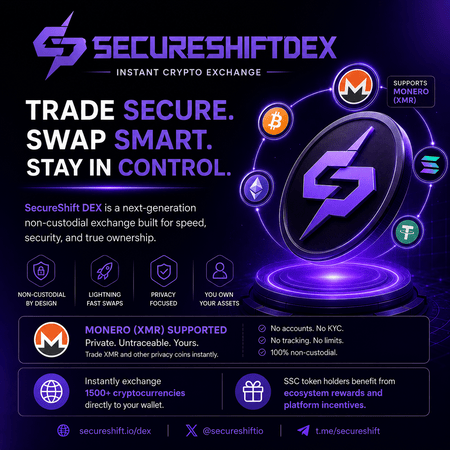
Popular swaps to try: BTC to XMR, ETH to BTC, BTC to USDT. Or trade on-chain with the SecureShift DEX.
Privacy-focused services attract scammers who copy their look. Watch for these warning signs:
We've put all of this into a practical no-KYC swap checklist you can run through in two minutes. You can also check what other users say in our public reviews. SecureShift is listed on BestChange, Monerica and XMR List.
In most countries, swapping your own crypto without an account is legal. But rules vary and they're changing, especially around privacy coins. The EU, for example, has plans to restrict how regulated platforms handle privacy coins from 2027. Our article on the EU's privacy coin rules explains what's planned. Check the rules where you live, and remember that privacy is not the same as breaking the law.
Not really. A no-KYC, no-account service keeps your identity out of the picture, but it still sees your addresses, amounts and IP, and most blockchains are public. Swapping into Monero gets you closest.
Card payments almost always need KYC, because card processors require it. No-account swaps are crypto to crypto. For Monero options, see how to buy Monero without KYC.
No. You don't need to register, give an email or upload ID. High-risk activity may still be reviewed under our AML policy.
The reputable ones are. Stick to services with clear terms, refund addresses and independent reviews, and always do a small test swap first.
A DEX runs on smart contracts and you trade from your own wallet, usually within one blockchain. An instant swap service handles cross-chain swaps for you, like BTC to XMR, without you needing to bridge anything.