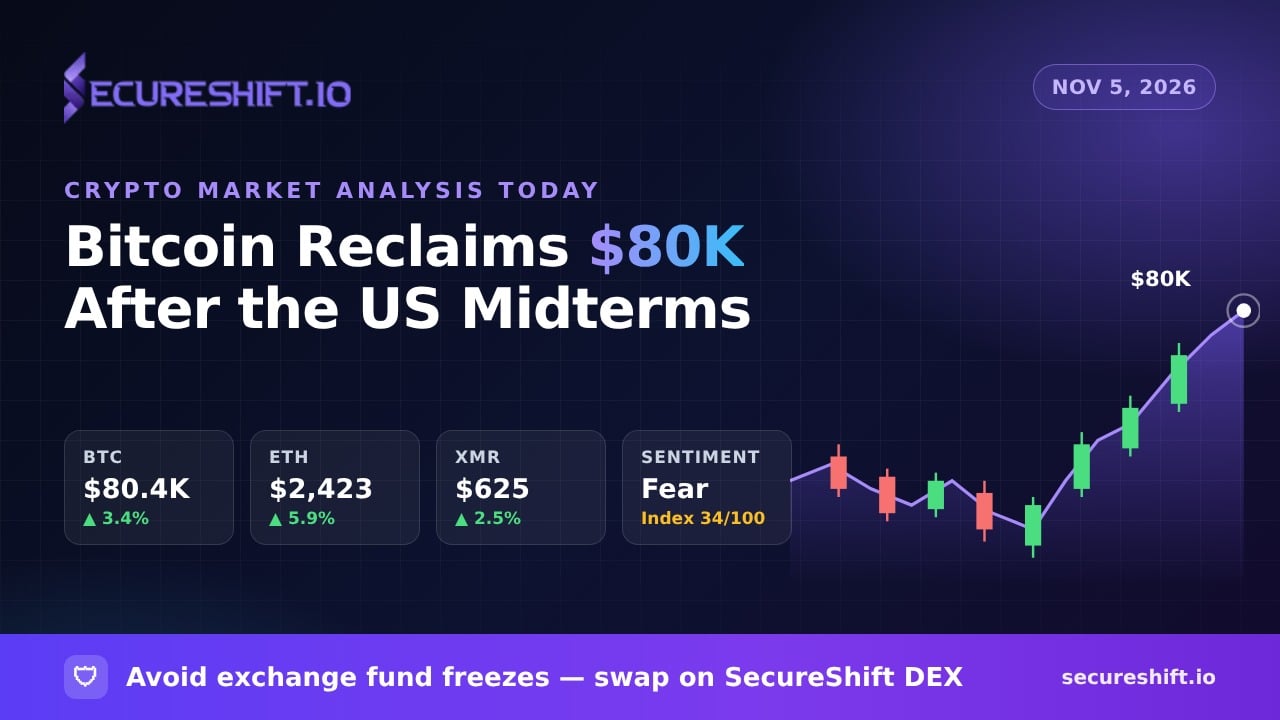
Crypto Market Analysis Today (Nov 5, 202...
2026-11-05

Key points: The EU's Anti-Money Laundering Regulation (AMLR) bans regulated crypto providers from offering anonymous accounts or handling "anonymity-enhancing" coins such as Monero (XMR) and shielded Zcash, starting 10 July 2027. It does not make owning Monero illegal, and it does not ban self-custody wallets. Here's what changes and how XMR users are adapting.
This article is for information only and is not legal advice.
The AMLR (Regulation (EU) 2024/1624) is part of the EU's AML package, adopted in 2024. It applies directly in every member state from July 2027. For crypto, it means:
EU-licensed exchanges have been preparing for this for a while. Several big centralised exchanges have already delisted XMR, either globally or in the EEA. Binance and OKX both removed it in early 2024, and Kraken followed for EEA users. Expect any remaining EU-licensed venues to drop privacy coins before the July 2027 deadline.
The result is that fewer custodial on-ramps exist for Monero. Demand for XMR hasn't disappeared, though. It has moved to self-custody wallets, atomic swaps and non-custodial instant swap services.
Use an official or well-reviewed wallet, back up your 25-word seed offline, and run your own node or a trusted remote node.
Non-custodial services such as SecureShift let you swap BTC to XMR or XMR to BTC wallet-to-wallet without opening an account. SecureShift never holds a balance for you. Like every reputable service, though, it screens transactions for AML risk and follows the laws that apply to it, so check that using any service is lawful where you live.
BTC↔XMR atomic swaps (for example via UnstoppableSwap or Haveno-based markets) need no middleman at all. They are slower and have less liquidity.
Delistings don't change your tax duties. Keep records of when you bought and sold, especially if a forced delisting made you sell.
Earlier delistings caused short-term drops, but XMR recovered each time because demand moved to non-custodial venues. The FCMP++ upgrade on the Monero roadmap also strengthens its privacy model, which matters to long-term holders. Read our Monero vs Zcash comparison for the bigger picture.
| Date | Event |
|---|---|
| Early 2024 | Binance and OKX delist XMR |
| 2024 | AMLR adopted and published in the EU Official Journal |
| 30 Dec 2024 | Crypto travel rule (TFR) and MiCA licensing apply |
| 2025–2026 | More EEA delistings of privacy coins |
| 10 Jul 2027 | AMLR applies: CASPs may not handle anonymity-enhancing coins |
No. The AMLR restricts regulated service providers, not individuals who hold XMR.
EU-licensed exchanges won't offer it. Self-custody, P2P and atomic swaps stay available. Whether a non-EU service can serve you depends on that provider's policy and your local law.
It covers coins with anonymity-enhancing features. Shielded Zcash transactions fall into that category. Transparent ZEC addresses are a grey area that national regulators will decide.