How to Buy Monero (XMR) With a Credit Ca...
2026-11-07

By the SecureShift Team · Updated November 7, 2026
Disclosure: SecureShift offers some of the services mentioned here. We cover alternatives too. This is educational content, not legal or financial advice.
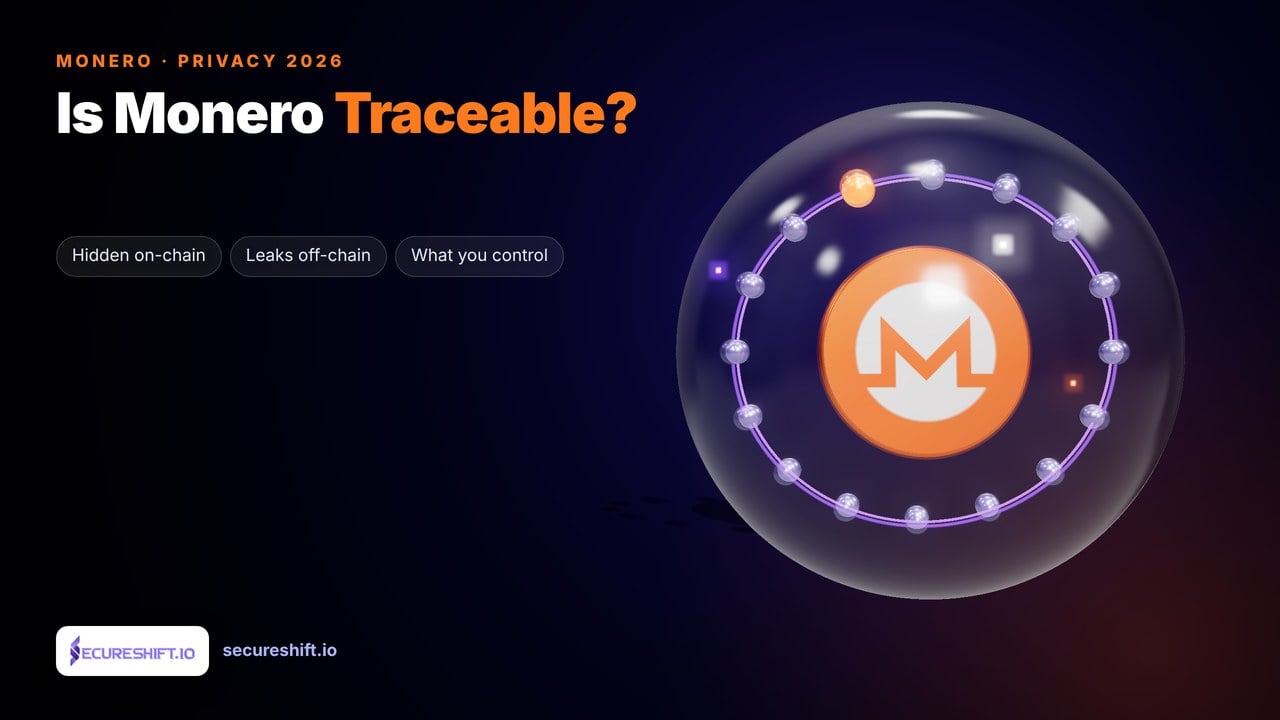
Not the way Bitcoin is. On its own blockchain, Monero hides the sender, receiver and amount of every transaction by default. Monero can still be linked to you off-chain: through exchange identity records, your IP address on a remote node, view keys you share, and your own habits.
On Bitcoin, anyone can follow coins from address to address. Monero was designed so that an outside observer can't do that. Three technologies work together on every transaction (Monero technical specs):
Because privacy is mandatory, every Monero transaction looks alike. Optional-privacy coins don't have that advantage, because the private transactions stand out.

| Hidden on-chain | Still visible on-chain | Can leak off-chain |
|---|---|---|
| Which output was spent (sender) | That a transaction happened | Identity records at exchanges |
| Who received it | Its timing and fee | Your IP on a remote node |
| How much was sent | Number of inputs and outputs | Anyone you give your view key |
| Your balance | The coin you swapped from (on its own chain) | Habits: timing, round amounts, posting addresses |
Early Monero (before RingCT and larger rings) was partly traceable, and academic papers showed that. Since then, the protocol has removed most of those weaknesses. In 2024, blockchain-analytics firm TRM Labs reviewed traceability research. It described heuristics such as a since-patched decoy-selection bug as reliable only in narrow cases, noted that the effective anonymity set "has still been growing over time", and called Monero one of the most private cryptocurrencies available (TRM Labs). Analytics firms still claim they can sometimes generate leads, mostly by combining on-chain guesses with off-chain data.
What's next: FCMP++ ("full-chain membership proofs") will replace 16-member rings with proofs over the whole set of outputs, which removes decoy analysis entirely. It's in public stress testing (stressnet v3.1 shipped October 26, 2026), and no mainnet activation date has been announced.
The weakest point is usually where XMR meets your identity. If you buy on an exchange that verified your ID, that exchange knows what you bought and where you withdrew it. Buying with a no-KYC swap changes what the service learns. It doesn't hide the coin you swapped from, though: a BTC or ETH deposit stays public on its own chain.
Get XMR into your own wallet with no account: BTC to XMR · ETH to XMR
Not on its blockchain the way Bitcoin is. Senders, receivers and amounts are hidden by default. Off-chain data such as exchange records and IP addresses can still link activity to a person.
Some say they can occasionally generate leads, mostly by combining narrow on-chain heuristics with off-chain data. Researchers note these heuristics have become much less effective as Monero improved.
Not by itself. A remote node can see your IP. Run your own node or connect over Tor for network-level privacy.
No. Your public address does not reveal your balance or transactions. Only someone with your view key can see incoming payments.
No. The Bitcoin side of the swap stays public on Bitcoin's chain. Only the Monero you receive gets Monero's privacy.
FCMP++ is a planned Monero upgrade that replaces 16-member ring signatures with full-chain membership proofs. It is in testing, with no mainnet date announced yet.