Crypto Coin Guides 2027: Every Coin You...
2026-11-12

By the SecureShift Team · Updated November 12, 2026
Disclosure: SecureShift runs a swap service and a cross-chain DEX, so we have skin in this game. We've tried to be fair about when a bridge is the better tool. Educational content, not financial advice.
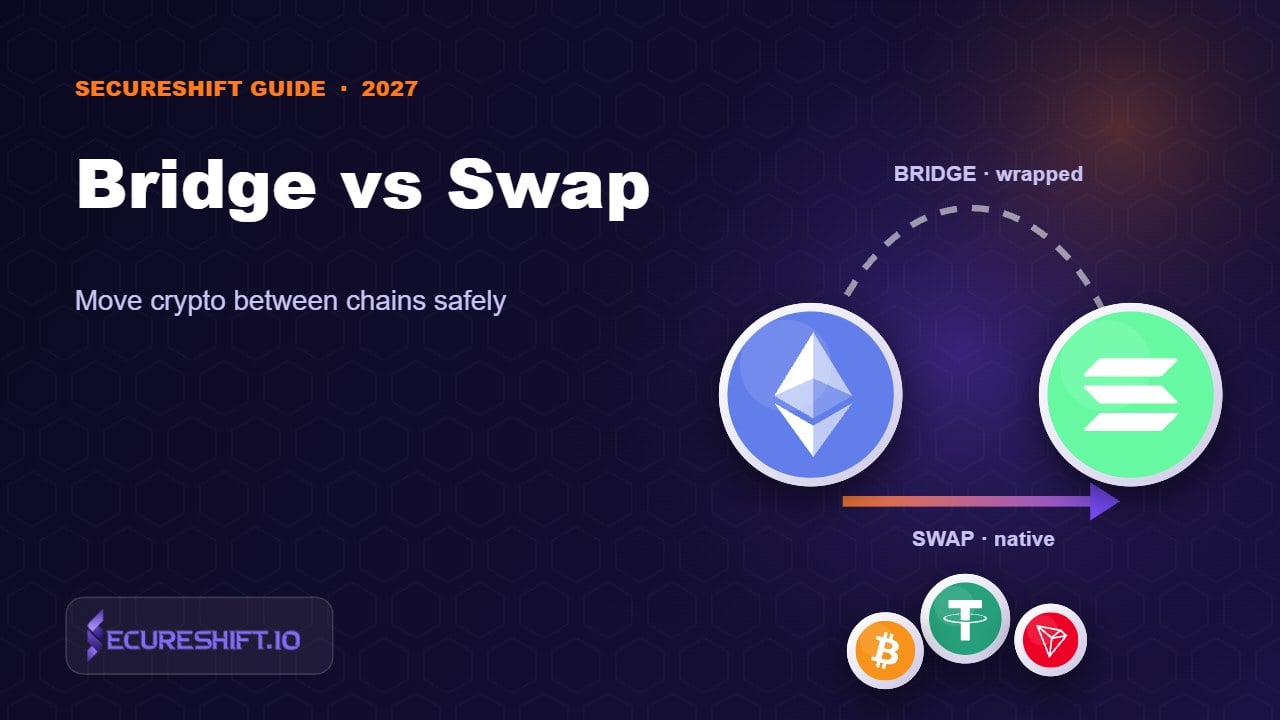
A bridge moves the same asset to another chain, usually by locking it on one side and minting a stand-in on the other. A cross-chain swap turns one coin into a different, native coin on the other chain. Use the chain's official bridge for large ETH or USDC moves between Ethereum and its own L2s. Use a swap when you're changing assets, going to a chain with no good bridge (Bitcoin, Monero, TRON, Solana), or when you don't want a wrapped token sitting in your wallet.
Every week someone in our support chat asks a version of the same question: "I've got ETH on Ethereum and I need it on X. Do I bridge it or swap it?" It sounds like a small decision. It isn't. Pick the wrong tool and you can pay three times the fees, wait a week for a withdrawal, or end up holding a token that's only worth something as long as one bridge contract stays solvent.
This guide is the answer we wish we could paste every time. No hype, a few opinions, and the trade-offs laid out plainly.
Blockchains can't see each other. Ethereum has no idea what's happening on Solana, and Bitcoin can't read either of them. A bridge is the go-between that makes one chain "believe" something happened on another.
Most bridges follow one of three patterns:
Then there are rollup "canonical" bridges, the official bridges for Arbitrum, Optimism, Base and similar L2s. Deposits from Ethereum arrive in minutes. Withdrawals back to Ethereum on optimistic rollups go through a challenge window of about seven days. That's not a bug. It's the security model. But it surprises a lot of people who need their money back on mainnet by Friday.
A swap doesn't try to move "your" coin anywhere. It exchanges it. You send ETH on Ethereum, and you receive SOL on Solana, BTC on Bitcoin, or XMR on Monero, all native coins on their home chains.
There are a few ways this happens under the hood:
The big practical difference: with a swap, you end up holding the real asset. There's no wrapped token whose value depends on a third-party vault.
Here's what's easy to miss. When you bridge ETH to some chains through a third-party bridge, the "ETH" in your wallet is often a wrapped version issued by that bridge. It looks like ETH. It has the ETH logo. Your wallet may even label it ETH. But it's only worth one ETH as long as:
If any of those fail, wrapped tokens can lose their peg overnight. Holders of Multichain-bridged tokens learned this in 2023, when assets on several chains suddenly had nothing reliable behind them.
A quick way to check what you're holding: look up the token's contract address on the destination chain's explorer and see who issued it. If the issuer is the bridge, not the asset's original creator, you're holding a wrapped claim. It might be fine. Just know what it is.
Our rule of thumb: wrapped tokens are fine for using, risky for storing. Bridge in, do the DeFi thing you came for, and don't leave a large balance parked in a bridged asset for months.
Bridges hold huge pools of locked funds behind a small set of keys or a complex verification contract. That makes them the most attractive target in crypto. 2022 was the worst year on record:
| Bridge | When | Loss (approx.) | What went wrong |
|---|---|---|---|
| Ronin (Axie Infinity) | Mar 2022 | ~$600M (173,600 ETH + 25.5M USDC) | Attackers got keys for 5 of 9 validators through social engineering |
| Wormhole | Feb 2022 | ~$325M (120,000 wETH) | A verification flaw let the attacker mint wrapped ETH on Solana with no backing |
| BNB Bridge (BSC Token Hub) | Oct 2022 | 2M BNB minted (~$570M); most frozen | Forged proof let the attacker mint new BNB |
| Nomad | Aug 2022 | $150M+ | A contract upgrade bug let anyone copy a valid transaction and drain funds. Dozens of wallets joined in. |
| Harmony Horizon | Jun 2022 | ~$100M | Compromised multisig keys |
| Multichain | Jul 2023 | ~$126M in "abnormal" outflows | Key control concentrated around the CEO, who had been detained weeks earlier. The project shut down. |
Look at the "what went wrong" column. Only some of these were exotic code exploits. The rest came down to who holds the keys. When a handful of signers control a vault worth hundreds of millions, those signers become the attack surface.
That doesn't mean every bridge is dangerous. Rollup canonical bridges and issuer-native systems like CCTP have a much better security story. But it does mean "which bridge?" matters far more than most people treat it.
| Bridge | Cross-chain swap | |
|---|---|---|
| What you receive | Same asset, often wrapped | A different, native asset |
| Cost | Gas on both sides; canonical bridges add no extra fee | Spread or service fee (1% on SecureShift) plus network fees |
| Speed | Minutes in; up to ~7 days out on optimistic rollups | Usually minutes, set by confirmations on the sending chain |
| Chains covered | Strong for EVM ↔ EVM; weak or none for BTC, XMR, TRON | Anything the service lists, including BTC, XMR, LTC, TRX, SOL |
| Main risk | Contract bugs, compromised signers, de-pegged wrapped tokens | Trusting the service to deliver; rate moves on floating swaps |
| Wallet setup | Need gas token on the destination chain to do anything | Just a receiving address |
| Best for | Large ETH/USDC moves to official L2s | Changing assets, non-EVM chains, getting gas on a new chain |
One line in that table deserves extra attention: gas on the destination chain. Bridge USDC to a new chain and you might find you can't move it, because you hold zero of that chain's native coin. A swap straight into the native coin (ETH on Arbitrum, SOL on Solana, TRX on TRON) gets around this.
This is probably the most common cross-chain move after ETH-to-L2, so it gets its own section. Tether issues USDT natively on both Ethereum (ERC-20) and TRON (TRC-20), but there's no official bridge between them. Your realistic options are:
Two things trip people up here. First, an ERC-20 transfer during busy hours on Ethereum can cost more than you expect, so on small amounts the gas matters more than the swap fee. We cover how to cut it in why crypto network fees are so high. Second, a TRON wallet needs a little TRX (or staked energy) to send USDT later. If you paste the wrong network address at any step, read our guide on sending USDT on the wrong network before you panic.
Swap into native coins on 1,300+ assets, with no account and no deposit balance. You choose a fixed rate (locked for 20 minutes) or a floating rate.
Start a swapOpen the DEXBridges and swaps aren't rivals. They solve different problems. If you're moving the same asset between Ethereum and its own rollups, the canonical bridge is hard to beat. For pretty much everything else (changing coins, going to Bitcoin, Monero, TRON or Solana, getting gas on a fresh chain, or just not wanting to trust a wrapped IOU), a swap is simpler and leaves you holding the real thing.
If you're unsure, ask yourself one question: "Do I want the same coin somewhere else, or a different coin?" That answer picks your tool nine times out of ten.
For large ETH moves to an official L2, the canonical bridge usually wins because you only pay gas. For changing assets or reaching non-EVM chains, a swap is often cheaper overall, because bridging and then swapping means paying twice.
They're as safe as the bridge that backs them. Wrapped tokens from major, well-audited bridges are widely used, but if the bridge is hacked or shuts down, the wrapped token can lose its peg.
Optimistic rollups assume transactions are valid unless someone proves fraud. The roughly 7-day window gives time for that challenge. Liquidity bridges and swaps let you skip the wait for a fee.
Not in any practical way, and it would undermine Monero's privacy anyway. To get XMR from another chain, use a swap such as ETH, BTC or USDT to XMR.
It depends on the chains and the wallet. EVM chains share address formats, so funds sent to the "right address, wrong chain" can sometimes be recovered with the same private key. Funds sent to a custodial deposit address on an unsupported network usually need the platform's support team.
No. You enter the coins, paste your receiving address, and send. There's no registration and no exchange limit.