Crypto Loan Without Selling Your Bitcoin...
2026-11-04

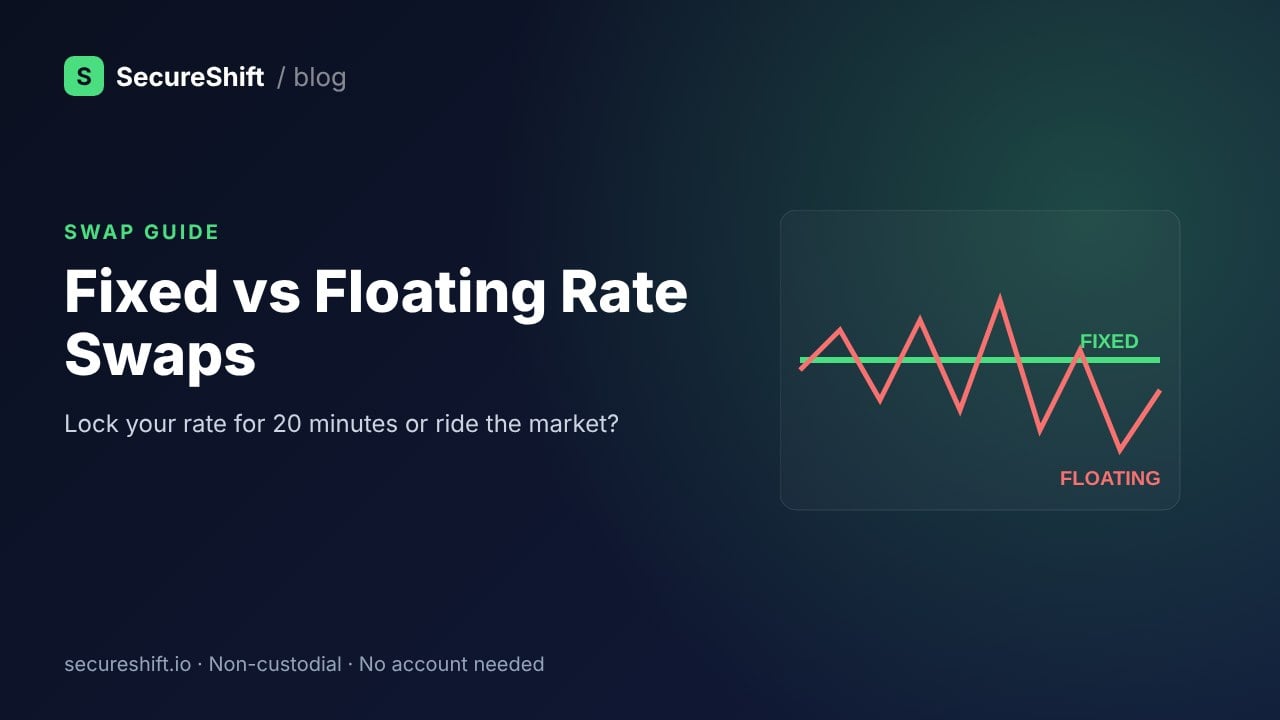
Short answer: choose a fixed rate when you need to know exactly what you'll receive, for example when paying someone, on volatile coins, or on slow blockchains. Choose a floating rate when the market is calm, the chain is fast and you're happy to accept small moves either way. On SecureShift both cost the same 1% service fee, so the choice is about certainty, not price.
The quote you see is an estimate. The final rate is set when your deposit is confirmed. If the market moves in your favour you receive more, and if it moves against you, you receive less.
The rate is locked when you create the order. On SecureShift the lock lasts 20 minutes. If your deposit arrives within that window, you get exactly the quoted amount, whatever the market does.
| Fixed | Floating | |
|---|---|---|
| Amount you receive | Guaranteed | Estimated |
| Market risk | Exchange takes it | You take it |
| SecureShift fee | 1% | 1% |
| Time limit | Deposit within 20 min | No rate deadline |
| Best for | Volatile pairs, slow chains, payments | Stable markets, fast chains |
Say the quote is 0.1 BTC → 40.00 XMR, and BTC drops 2% against XMR while your Bitcoin deposit confirms.
Had BTC risen 2% instead, the floating order would have paid about 40.80 XMR. Floating gives you the upside and the downside.
If your funds arrive after the 20-minute window, for example because of a low network fee, the locked rate can no longer be honoured. The order may then be recalculated at the current market rate or refunded. Our support team will confirm which applies to your order. To avoid this, send promptly with a normal or high network fee. See why swaps get delayed.
No. Fixed and floating swaps both have a 1% service fee. Network fees are separate.
20 minutes from the moment you press Exchange.
For BTC→XMR, a fixed rate is usually safer, because Bitcoin confirmations can take a while.
Both rate types have their place. A fixed rate gives certainty, which is valuable during volatile markets or for large swaps. A floating rate usually offers a slightly better price and suits smaller swaps or calm markets.
Remember that fixed rates come with a time window. If your deposit arrives late, the order may be recalculated or refunded.
Choose fixed when you want to know exactly how much you will receive, especially during volatile markets.
A floating rate is usually slightly better and works well when markets are calm or you can wait for the final amount.
Yes. You must send your deposit within the order time window, or the fixed rate may no longer apply.