What Is a Seed Phrase? How to Store Your...
2026-11-12

By the SecureShift Team · Updated November 12, 2026
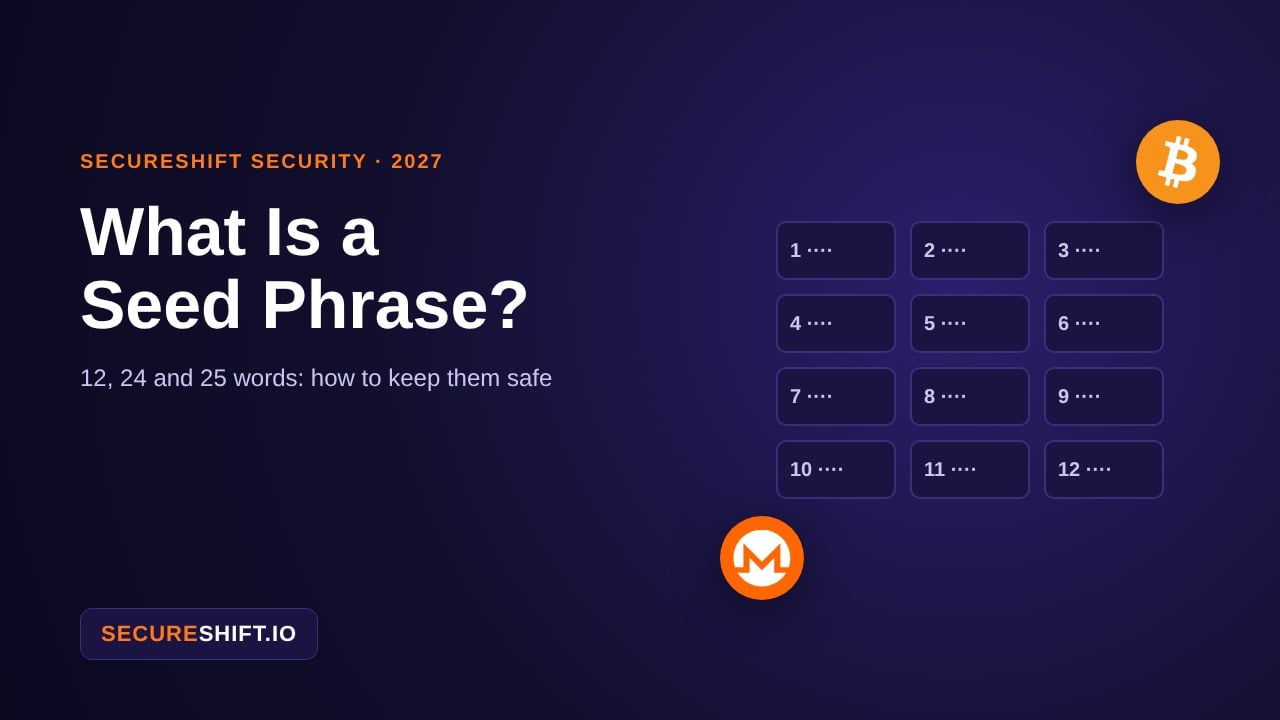
A seed phrase (also called a recovery phrase) is a list of 12 or 24 words (25 for Monero) that your wallet generates when you set it up. Those words are your wallet: anyone who has them can take your crypto from any device, and if you lose them and your phone dies, the funds are gone for good. Write it on paper or metal, keep it offline, and never type it into a website or share it with "support".
When you create a new crypto wallet, there's a moment where the app shows you a list of random words and asks you to write them down. Most people rush through it. It's probably the single most important step in owning crypto yourself, and a careless backup is behind a huge share of the losses we hear about from users.
Your wallet doesn't store coins. The coins live on the blockchain. What your wallet holds are private keys, the secrets that let you spend those coins. A seed phrase is a human-readable version of the master secret that all those keys are generated from.
That has two big consequences. First, you can restore your whole wallet, every address and every coin, on a new device just by typing in the words. Second, anyone else can do exactly the same thing. There's no password reset, no bank to call, no "forgot my seed" button. Whoever has the words controls the money.
The words come from a fixed list. For most wallets that's the BIP39 standard list of 2,048 English words, chosen so that the first four letters of each are unique. That's why some metal backup plates only have room for four letters per word.
Word order matters. "apple river stone" and "river apple stone" create completely different wallets. Number your words as you write them.
Most crypto theft isn't clever hacking. It's someone persuading you to hand over the words. The usual patterns:
We cover more of these in 9 crypto scams and how to spot each one. The short version: if anyone asks for your seed phrase, it's a scam. Every time.
Many wallets let you add an optional passphrase, sometimes called a 25th word on Bitcoin wallets (not to be confused with Monero's 25th word). It creates a completely separate hidden wallet. Someone who finds your written seed but not the passphrase only sees the decoy wallet. The catch: forget the passphrase and those funds are lost, so back it up separately.
For very large holdings, look into multisig, where moving funds needs two of three keys, or Shamir backups, which split a seed into shares. They add complexity, so only use them once you're comfortable with the basics.
SecureShift never holds your funds or asks for your seed. Swap straight from your wallet to your wallet. No account, no exchange limit.
Start a swapSetting up a privacy wallet? See our picks for the best Monero wallets.
Not quite. A private key controls one address. A seed phrase is the master backup that every private key in the wallet is derived from.
If your wallet still works, create a new wallet right away, back up its new seed properly, and move your funds over. If the device is also gone, the funds can't be recovered.
Not realistically. A 12-word BIP39 seed has 2128 possible combinations, far more than could be tried with all the computing power on Earth.
Usually, if both apps use the same standard. BIP39 seeds move between most Bitcoin and Ethereum wallets. Monero seeds work across Monero wallets. You may need to choose the right address type or derivation path.
It's better than a screenshot, but it's still online. For any meaningful amount, keep it offline on paper or metal.