Bitcoin (BTC) Price Prediction 2026 - 20...
2026-09-26

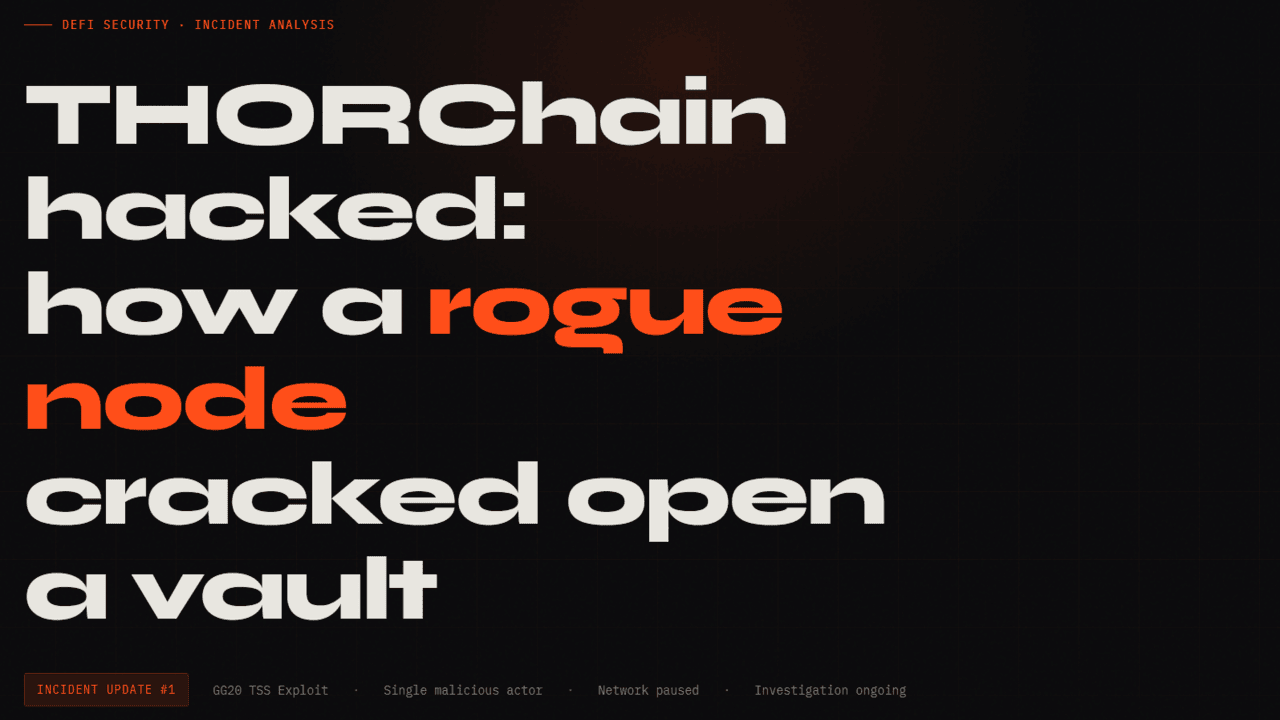
A deep technical breakdown of the GG20 TSS exploit and what it means for decentralized infrastructure.
THORChain — the decentralized cross-chain liquidity protocol — was hit by a significant exploit that forced the entire network into a paused state. According to the official incident update from THORChain contributors, the damage traces back to a single malicious node operator who may have weaponized a subtle cryptographic vulnerability in the protocol's threshold signing implementation to reconstruct a vault private key and drain funds.
This isn't a smart contract bug. It isn't a rug pull. It's something considerably more technically sophisticated — and more alarming.
To participate in THORChain's network as a validator node, an operator must bond RUNE as collateral and wait to "churn in" the process by which new nodes replace older ones in the active signing set. According to the announcement, the node identified as thor16ucjv3v695mq283me7esh0wdhajjalengcn84q entered the network several days before the attack and is believed to be linked via on-chain forensics to Ethereum addresses that later received the stolen funds.
This is a patient attack. The malicious operator didn't strike immediately they waited inside the network, quietly participating in the vault's threshold signing ceremonies.
This is where the attack becomes genuinely novel and technically alarming.
THORChain, like many cross-chain protocols, uses Threshold Signature Schemes (TSS) to manage cross-chain vaults. Rather than any single node holding a private key, the key is cryptographically split across all participating nodes. No individual node should ever possess the full key that's the whole point.
The specific implementation used is GG20 (Gennaro-Goldfeder 2020), a widely-referenced multi-party ECDSA protocol. The leading theory from developers and THORSec is that the attacker exploited a vulnerability in this GG20 implementation that caused partial key material to leak incrementally during normal signing ceremonies. Over time, by accumulating enough leaked shards, the attacker was able to reconstruct the vault's full private key something that should be cryptographically impossible by design.
This is not a novel class of vulnerability conceptually. Academic research has identified "key extraction" weaknesses in some multi-party computation (MPC) protocols where a malicious participant can extract bits of other parties' secret shares across multiple protocol rounds. The GG20 paper itself acknowledges the importance of using "identifiable abort" variants to prevent such attacks. The critical question which investigators are still working through - is whether this was a known weakness exploited via a deliberate implementation flaw, or something more subtle.
With a fully reconstructed vault private key in hand, the attacker no longer needed to coordinate with other nodes. They could sign and broadcast outbound transactions unilaterally, bypassing THORChain's normal multi-party consensus entirely. The funds moved directly to Ethereum addresses that forensic analysis has now linked back to the bonding addresses used to set up the rogue node in the first place.

Multiple node operators executed make pause, a governance-level command that halts the network at the infrastructure layer. This is THORChain's emergency brake and it worked. The network froze before the damage could compound.
The current operational status:
No final decisions have been made. Full functionality including trading is expected to be offline for several days at minimum, possibly longer depending on the chosen recovery path.
The broader implication here is significant for the entire DeFi and cross-chain infrastructure space. TSS and MPC-based key management are increasingly popular precisely because they eliminate single points of failure. Projects like THORChain, various bridge protocols, and institutional custody providers all rely on variants of these schemes.
If GG20 (or its implementations) have exploitable leakage vulnerabilities in adversarial multi-party settings where one participant is actively malicious this is a wake-up call for the entire ecosystem. The attack surface isn't just smart contract code. It's the cryptographic ceremony itself.
Key questions the investigation will likely need to answer:
The investigation is still live, with THORSec and Outrider Analytics coordinating alongside law enforcement. On-chain forensics are already linking the attacker's node setup funds to the destination addresses which could help recovery efforts and, potentially, identification.
For the community, the coming days will be a governance stress test: how THORChain's node operators, developers, and liquidity providers collectively decide to absorb and remediate losses will say a lot about the protocol's long-term resilience. The transparent communication from the core team so far has been notably measured and honest a good sign in a space where incident communication often ranges from evasive to chaotic.
The technical post-mortem, when it comes, will be essential reading for anyone building on MPC-based infrastructure. Until then, the network waits, paused, but not broken.
Sources: Official THORChain incident update #1, published via the dev discord and @THORChain on X.
(1)-1790417752.png)

-1788346309.png)