Crypto Loans Explained: How to Borrow Ag...
2026-07-26

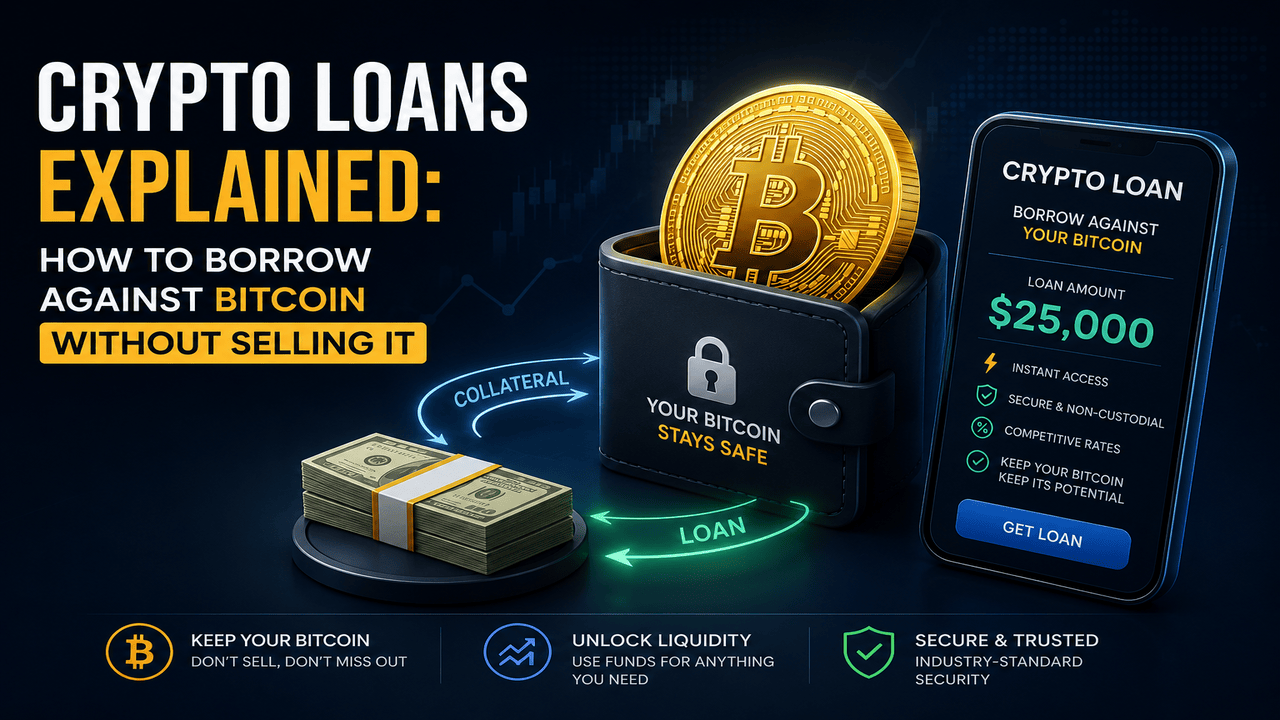
Instant liquidity from your BTC, ETH, XRP or 200+ other coins, no credit check, no bank, and no taxable sale. Here's how crypto-backed loans work on SecureShift, and what borrowers in India, the USA and Germany should know before pledging collateral.
Every long-term crypto holder eventually hits the same wall: you need cash, but selling your coins feels wrong. Selling means giving up future upside, resetting your position, and in most countries handing a slice of your gains straight to the tax office.
A crypto-backed loan solves that problem. You pledge your cryptocurrency as collateral, receive stablecoins or crypto in your wallet within minutes, and get your collateral back the moment you repay. Your coins never leave your ownership, your market exposure stays intact, and in most jurisdictions no taxable disposal takes place.
This guide explains how crypto loans work on SecureShift, how to choose the right loan-to-value ratio, the real risks involved, and the country-specific angles that matter for borrowers in India, the United States, Germany, and other major crypto markets.
A crypto-backed loan (also called a crypto collateral loan) lets you borrow fiat-pegged stablecoins or other cryptocurrencies against digital assets you already own. Think of it like a home equity loan, except instead of pledging your house, you pledge your Bitcoin, Ethereum, XRP or altcoins.
Because the loan is fully collateralized, the lender takes no credit risk on you personally. That is why on SecureShift there is:
All you need is a verified email address, a collateral deposit, and a payout wallet.
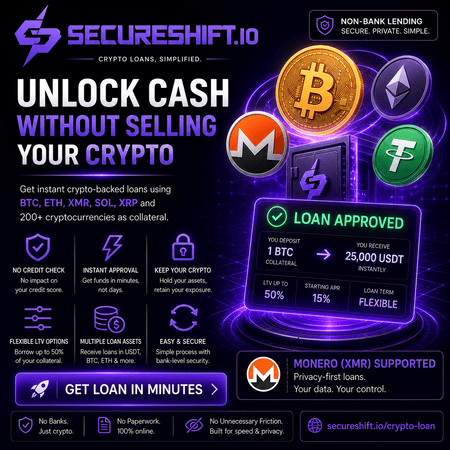
SecureShift offers two loan structures: a 30-day fixed-term loan and an unlimited open-ended loan that stays active as long as your collateral health ratio holds. Both start from 15% APR, and collateral sits in institutional-grade cold storage with multi-signature security for the life of the loan.
Loan-to-value (LTV) is the percentage of your collateral's market value you receive as a loan. It is the single biggest lever you control, because it determines both how much liquidity you unlock and how close you sit to liquidation if the market drops.
| LTV Tier | $10,000 Collateral Gets You | Price Drop Buffer | Best For |
|---|---|---|---|
| 50% | $5,000 | Large | Conservative holders, volatile altcoin collateral |
| 65% | $6,500 | Moderate | Balanced borrowers |
| 80% | $8,000 | Small | Experienced users who monitor positions |
| 90% | $9,000 | Very small | Short-term liquidity, active management only |
Rule of thumb: the more volatile your collateral, the lower your LTV should be. Pledging Bitcoin at 50% LTV gives you a wide buffer against ordinary market swings; pledging a small-cap altcoin at 90% LTV can put you within a single red candle of a margin call.
The strongest argument for a crypto loan is simple: in most major jurisdictions, borrowing is not a disposal. Selling crypto typically triggers tax; pledging it as loan collateral typically does not. Here is how that plays out in the three biggest markets though tax law evolves quickly, so treat this as orientation, not advice.
India taxes gains on virtual digital assets (VDAs) at a flat 30%, with no loss offsets and a 1% TDS deducted on transfers above the threshold. For an Indian holder sitting on unrealized BTC or ETH gains, selling to raise cash is one of the most expensive liquidity options available anywhere in the world.
Borrowing against those coins instead means no sale, no realized gain, and no 30% haircut, you unlock liquidity while your position stays intact. Indian users also appreciate that SecureShift requires no PAN, no bank linkage and no credit bureau involvement: the entire process runs wallet-to-wallet.
In the United States, selling crypto held over a year triggers long-term capital gains tax of up to 20% (plus potential state tax and net investment income tax); selling within a year is taxed as ordinary income. Loans, by contrast, are generally not taxable income the same principle that lets stockholders borrow against equity portfolios applies to crypto collateral.
For US holders, a crypto loan can mean accessing cash for a large expense while deferring the taxable event entirely and if you never sell, your heirs may benefit from stepped-up basis treatment. The absence of a credit check also means the loan never touches your FICO score or debt-to-income calculations.
Germany has one of the most crypto-friendly tax regimes in the world: private crypto sales are completely tax-free after a 12-month holding period under §23 EStG. But that creates a painful dilemma if you need cash in month 8, selling means paying full income tax on gains you could have realized tax-free just four months later.
A crypto loan resolves the dilemma elegantly: borrow against your coins now, keep holding, and let the one-year clock run out. For German holders approaching the Haltefrist deadline, borrowing instead of selling is arguably the most valuable use case for crypto-backed lending anywhere.
The same borrow-don't-sell logic applies across most of the world's largest crypto user bases. In Vietnam, Nigeria, Brazil, Indonesia, the Philippines and Turkey, consistently among the top countries for crypto adoption holders face a mix of capital gains regimes, banking restrictions, and volatile local currencies. A stablecoin loan against crypto collateral provides dollar-denominated liquidity without touching the local banking system, without a credit history, and without liquidating a long-term position. In the UK, Canada and Australia, where crypto disposals trigger capital gains tax, collateralized borrowing generally does not count as a disposal.
Crypto loans are not free money. They carry real risks that traditional loans do not, and high-LTV positions can be lost quickly in a crash. Borrow conservatively.
If your collateral's value falls toward the liquidation threshold, you receive a margin call to add collateral or repay part of the loan. If you don't act in time, a portion of your collateral is automatically sold to protect the outstanding balance. At 90% LTV, even a routine 10–15% market dip can trigger this; at 50% LTV you have far more room.
Crypto moves fast, and flash crashes happen outside business hours. If your collateral is a volatile altcoin, price can fall through the margin-call zone before you react. Choose lower LTV tiers for volatile collateral and monitor your health ratio.
Interest accrues monthly from the day the loan is issued and is payable at repayment. On unlimited-duration loans, an unmonitored position left open for a long time can accumulate significant interest. Set reminders, and repay early when you can SecureShift charges no prepayment penalty, so early repayment always reduces total cost.
| SecureShift Crypto Loan | Bank Personal Loan | Selling Your Crypto | |
|---|---|---|---|
| Approval time | Minutes | Days to weeks | Instant |
| Credit check | None | Required | N/A |
| Taxable event | Generally no | No | Yes, in most countries |
| Keep crypto upside | Yes | N/A | No |
| Availability | 24/7, global | Banking hours, residents only | 24/7 |
| Main risk | Liquidation if price falls | Credit score damage | Missing future gains |
In most major jurisdictions including India, the USA and Germany receiving a collateralized loan is generally not treated as a disposal or as income, so it does not by itself trigger the taxes a sale would. A forced liquidation of your collateral, however, usually is a disposal. Confirm your situation with a local tax professional.
Your loan equals your collateral value multiplied by your chosen LTV. Deposit $10,000 in BTC at 65% LTV and you receive $6,500 in USDT, USDC or another supported payout asset.
Over 200 cryptocurrencies, including BTC, ETH, XRP, SOL, BNB, ADA, DOGE, SHIB, LTC, XMR and a long tail of altcoins. See the full list on the crypto loan page.
Yes. The rate is locked at loan creation and never changes for the life of the loan, regardless of market conditions.
Automatically, within seconds of your full repayment (principal + accrued interest) confirming on the blockchain.
Yes, at any time, with no prepayment penalty. Early repayment reduces the total interest you pay.
Unlock liquidity without selling your cryptoInstant approval · No credit check · 200+ collateral coins · From 15% APR
Calculate your crypto loan on SecureShift →
Disclaimer: This article is for informational purposes only and does not constitute financial, investment, legal or tax advice. Cryptocurrency prices are highly volatile, and crypto-backed loans carry liquidation risk — you can lose part or all of your collateral if its value falls. Tax treatment of crypto loans varies by jurisdiction and individual circumstances and may change; consult a qualified tax professional in your country before borrowing. Availability of services may depend on your jurisdiction.