Bitcoin Dominance: Complete Guide to Und...
2026-09-04

Introduction
Thousands of cryptocurrency projects launch every year promising to change the world. Many attract investors, build communities and see their token price rise quickly.
Then something funny happens.
The project keeps growing, but the token price keeps dropping.
Why?
Most of the time, the answer is tokens emissions.
One of the most important skills to understand for anyone investing in crypto is token emissions. It helps explain why some projects boom for years, while others languish and lose value.
Let’s break it down in simple terms.
Token emissions are new tokens that a project puts into the market over time.
It's like printing money.
For example, if a crypto project has a total supply of 1 billion tokens but only 200 million are available at the moment, then the remaining 800 million tokens will probably be released gradually.
These new tokens could go to:
This process is known as token emission.
It's easy to think of emissions as a bad thing.
But they aren't always a problem.
Emissions are used in projects to:
Many blockchain networks reward those who secure the network.
Less people would participate without rewards.
Some projects distribute tokens to users for offering liquidity or for using their platform.
This helps to grow adoption.
Teams can save tokens to pay developers and continue building the project.
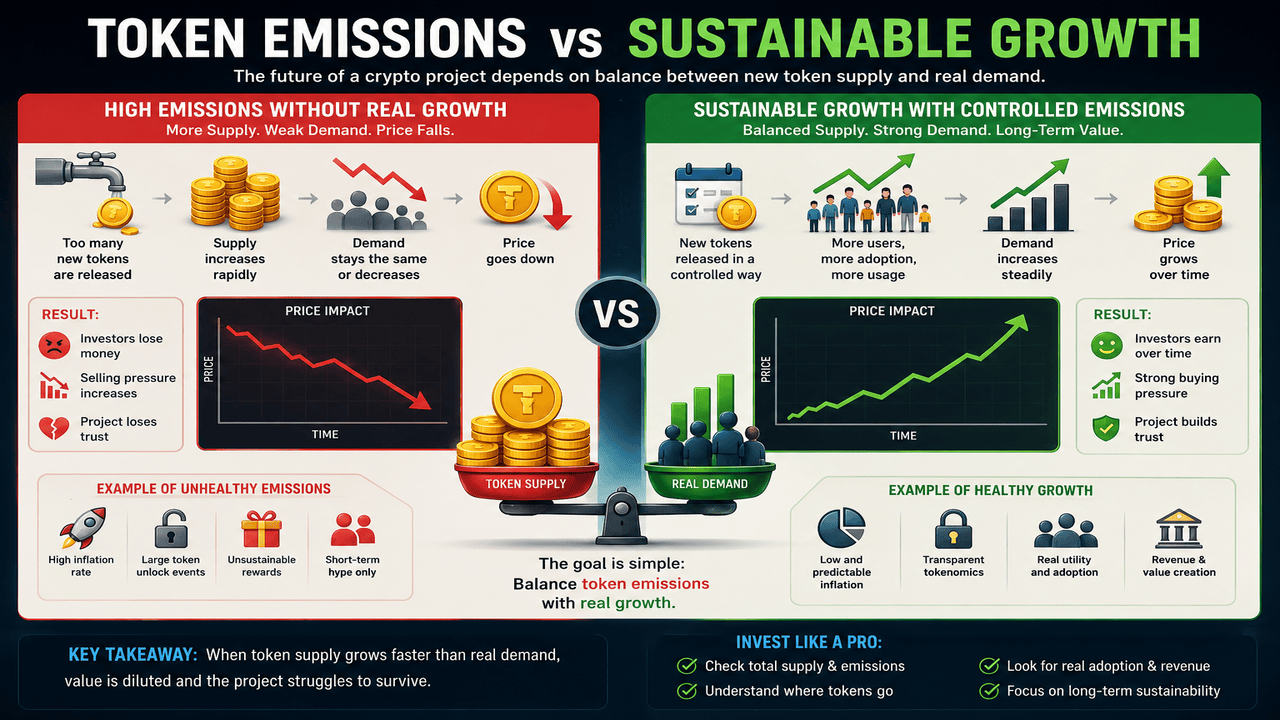
The problem starts when the emissions are too large.
Suppose the market price of a token is $1.
The project mints 50 million new tokens every month.
If demand is for only 10 million tokens then there is more supply than demand.
Prices are likely to fall when supply exceeds demand.
That is basic economics.
Plenty of supply.
Not enough purchasers.
Prices fall.
Sustainable growth is when the project’s real world usage is increasing faster than its token issuance.
Don't know what to tell you.
Project A is minting 10 million new tokens each month.
But at the same time :
In this case the demand may absorb the new supply.
The token can stay healthy despite emissions.
Some crypto projects offer high staking rewards.
For instance:
"Stake your tokens and get 200% per annum".
Sounds awesome.
But where do those rewards come from?
They often arise from the printing of extra tokens.
That creates a cycle:
Looks like people are making money and the project is a success.
But in reality value is just being transferred from future investors to current holders.
The system eventually collapses.
Consider two businesses.
A pizza shop makes money from selling pizza.
When customers buy products, revenue is realised.
A pizza shop lives on handing out coupons and printing coupons .
The business doesn’t earn more money.
It just spits out more coupons.
Which business would you believe more?
Most people would pick Business A.
Crypto is like that.
Projects with real revenue are generally healthier than projects that rely only on token emissions.
Ask these questions before buying any token:
Many projects have big amounts of supply that will unlock later.
Future unlocks may add to selling pressure.
Are they going to be users?
Developers ?
Venture capital companies?
It is important to know where the tokens end up.
Projects with actual income tend to be more sustainable.
If the number of users is not growing and emissions are still increasing, there could be problems later.
Good projects tend to have some of the following traits:
These projects aren’t about printing more tokens, they’re about creating value.
The most famous example of sustainable token issuance is bitcoin.
Why?
Because Bitcoin’s emissions are cut in half every four years in an event called a halving.
It becomes harder to get new coins into circulation over time.
Meanwhile demand has generally increased.
That has helped underpin the long-term value of Bitcoin.
Many investors just look at the price of a token.
Smart investors look at supply and demand.
An project can be:
But it will still struggle if too many new tokens are being released.
The most successful crypto projects are not always the ones that are printing the most rewards.
They are the ones that create real value and keep token emissions in check.
Token issuances are not inherently bad. They help reward users, secure networks and fund development.
But emissions become dangerous when new supply outpaces actual demand.
Before you invest in any crypto project, ask yourself a simple question:
“Is this project creating value, or just creating more tokens?
The answer often dictates whether a project grows sustainably or loses value slowly over time.

-1788346309.png)
(1)-1788345096.png)