Bitcoin (BTC) Price Prediction 2026 - 20...
2026-09-26

(1)-1781512961.png)
If you've ever sat staring at a "pending verification" screen on a crypto exchange, wondering why a company you've never met needs your passport photo just to let you trade your own money you already understand the itch that decentralized exchanges are trying to scratch.
SecureShift DEX is one of the newer entrants chasing that itch, and after spending some time with it, it's worth breaking down what it actually does, how it's different from the dozens of other "swap anything, anywhere" platforms out there, and whether it's something worth bookmarking.
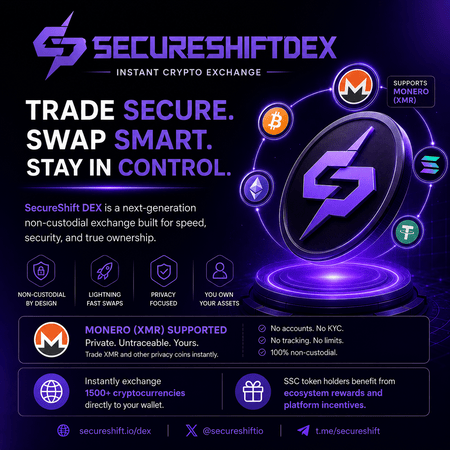
At its core, SecureShift DEX is a decentralized, cross-chain token swap platform. That's a mouthful, so here's the plain-English version: it's a website where you can trade one cryptocurrency for another even if the two coins live on completely different blockchains without creating an account, without handing over your ID, and without ever giving up control of your funds to a middleman.
The platform's own numbers give a sense of scale: over $2.4 billion in total volume processed, support for more than 1,300 token pairs, and a flat 0.1% swap fee on top of standard pool fees. Whether those figures impress you or not depends on what you're comparing them to, but they at least suggest this isn't a ghost-town project there's real activity happening.
The tagline that sums up the whole pitch is right there on the homepage: "Fully On-Chain · Non-Custodial · Zero Registration · No Hostage." Let's unpack what each of those words actually means in practice, because in crypto, marketing language and reality don't always match up.
This is probably the most interesting line on the entire page, and it's easy to scroll past it. Most centralized exchanges and even some "non-custodial" services have a moment where your funds are technically in transit and not fully under your control. If something goes wrong during that window (a frozen withdrawal, a stuck transaction, a support ticket that goes unanswered for a week), your money is effectively held hostage until someone on the other end decides to release it.
SecureShift describes its approach as an "AML before swap" model, meaning compliance checks happen before a swap is initiated rather than after funds are already locked in limbo. The practical result, according to the platform, is that funds can't get stuck mid-transaction waiting on a manual review. If something does go wrong during a swap, the FAQ states that the system automatically processes a refund back to the original wallet no support ticket, no waiting game.
For anyone who has ever had a centralized exchange freeze a withdrawal "for review" with zero timeline given, this is the kind of detail that actually matters.
"Non-custodial" gets thrown around a lot, sometimes loosely. In SecureShift's case, the claim is straightforward: your funds stay in your wallet, and smart contracts execute the swap directly. There's no internal balance sheet, no IOU system, no "trust us, your crypto is in cold storage somewhere."
This is the same underlying philosophy behind the famous crypto mantra "not your keys, not your coins" except applied to the exchange layer instead of just storage. You're not depositing funds into SecureShift's custody and waiting for them to send something back. The swap happens, on-chain, directly between your wallet and the liquidity pool.
Let's be honest - for most people, the headline feature isn't the technical architecture. It's this: no account, no email, no KYC document upload, no waiting period.
You land on the page, pick what you have, pick what you want, enter a destination wallet address, and go. The FAQ confirms this directly: "SecureShift DEX doesn't ask for registration, KYC, or even an email."
For privacy-conscious users, frequent traders who hate friction, or anyone in a region with shaky access to traditional exchange onboarding, this removes the single biggest barrier that exists on most platforms.
One detail that stands out is that SecureShift's flow doesn't require you to connect your wallet in the traditional Web3 sense no MetaMask pop-up, no signature request, no approving token allowances. Instead, the process works more like a traditional instant exchange, but settled on-chain:
Step 1 — Select & Enter. Choose your pair (say, BTC → ETH), enter the amount, and paste in the recipient wallet address where you want the swapped coins delivered.
Step 2 — Review & Confirm. The platform shows you the swap details - including the best rate sourced across DEX liquidity pools — and you confirm. The transaction is then broadcast on-chain.
Step 3 — Receive Instantly. Swapped tokens land directly in the recipient address. SecureShift cites an average settlement time of around 15 seconds, with no intermediary holding the funds along the way.
This "best rate across DEX pools" detail is also worth noting it implies SecureShift is acting as an aggregator, scanning multiple liquidity sources to route your trade through the most favorable pool rather than relying on a single pool that might give you a worse price.
The DEX currently lists support across several major networks, each marked as "Live":
That Bitcoin and Monero are both included alongside the usual EVM suspects is notable. Bitcoin doesn't have native smart contract functionality, and Monero is famously privacy-focused and rarely integrated into DEX aggregators at all — so seeing both supported for cross-chain swaps suggests SecureShift has built out infrastructure specifically to bridge assets that most "DEX" platforms quietly ignore because they're technically harder to support.
If you've ever tried to move value between, say, XMR and SOL, or BTC and BNB, without routing through two or three centralized exchanges first, you'll know why this matters.
SecureShift's fee structure follows a fairly standard tiered AMM model:
On top of pool-level fees, there's a flat 0.1% swap fee for the platform itself. According to the FAQ, pool fees flow to liquidity providers, while SSC token holders receive 50% of protocol revenue a detail that gives the platform's native token actual utility tied to trading volume, rather than being purely speculative.
Two terms come up in the FAQ that every new DEX user should genuinely understand before swapping anything sizeable:
Slippage is the gap between the price you expect and the price you actually get, caused by the trade itself moving the pool's price. SecureShift sets a default tolerance of 0.5%, adjustable in settings useful to know if you're trading larger amounts or less liquid pairs, where you may need to loosen that tolerance to avoid a failed transaction.
Impermanent loss only applies if you're providing liquidity rather than just swapping it's the risk that the relative price of your two deposited tokens shifts so much that you'd have been better off just holding them. The FAQ is upfront that trading fees often offset this, especially in high-volume pools, but it's not a guarantee.
The fact that these concepts are explained at all rather than buried is a small but meaningful signal that the platform expects (and is trying to educate) users who are newer to DeFi mechanics, not just seasoned degens.
The page itself draws this contrast directly, even linking to a "Try CEX Instead" option for users who'd rather use SecureShift's centralized exchange product. That's a fairly transparent move most platforms don't openly point users toward an alternative version of themselves.
The trade-offs are roughly what you'd expect from any CEX-vs-DEX comparison:
A centralized exchange typically offers more familiar UX, fiat on-ramps, and customer support but requires KYC, holds your funds during the trade, and introduces counterparty risk (see: every major exchange collapse in crypto history).
A decentralized exchange like SecureShift's offers self-custody, no registration, and on-chain transparency but you're responsible for getting your wallet addresses right (there's no "undo" on a blockchain), and rates depend on pool liquidity rather than a centralized order book.
Neither is objectively "better" it depends on whether you're optimizing for convenience or for control.
Based on everything above, SecureShift DEX seems to be aimed at a few overlapping groups:
Traders who want to swap across chains without bridging manually particularly between assets like BTC, XMR, and SOL that don't always play nicely with standard bridge infrastructure.
Privacy-focused users who don't want their swap history tied to a KYC'd identity, especially relevant given Monero's inclusion.
DeFi users who are tired of connecting wallets to every new dApp and approving token allowances, since the flow here mimics a traditional "enter address, get coins" exchange experience while settling on-chain.
Anyone burned before by a frozen withdrawal, who specifically values the "no hostage" automatic-refund mechanism over a slightly cheaper fee elsewhere.
No DEX review is complete without acknowledging the obvious: because there's no account, there's also no account recovery. If you paste the wrong destination address, the swap goes to that address — permanently. Double-checking the recipient wallet address before confirming isn't optional; it's the entire safety net.
It's also worth checking current liquidity for whatever pair you're trading, especially for the "exotic pair" 1% fee tier mentioned above — low liquidity can mean higher slippage even with the rate-aggregation feature working in your favor.
Finally, while the AML-before-swap model is designed to prevent the platform itself from freezing funds, it's still worth understanding what that screening actually checks — SecureShift's AML/KYC policy page lays out the specifics for anyone who wants the full picture before swapping larger amounts.
SecureShift DEX is making a clear bet: that the future of crypto trading belongs to platforms that get out of the user's way — no accounts, no custody, no waiting rooms — while still building in safeguards (automatic refunds, AML-before-swap, multi-pool rate aggregation) that address the legitimate reasons centralized exchanges exist in the first place.
Whether it becomes your go-to swap tool probably comes down to one simple test: try a small swap first. Pick a pair you're comfortable with, send a modest amount, and see how the ~15-second settlement and refund-on-failure mechanics actually hold up in practice. That's a far more useful signal than any marketing copy — including this article.
👉 Ready to try it yourself ? Swap your first pair on SecureShift DEX and see the on-chain settlement speed for yourself.
What is SecureShift DEX? SecureShift DEX is a non-custodial, cross-chain token swap platform that lets users trade cryptocurrencies like BTC, ETH, SOL, and XMR directly on-chain without registration or KYC.
Do I need a crypto wallet account to use SecureShift DEX? No traditional wallet connection is required. You simply enter the amount, select your coins, and provide the destination wallet address — the platform handles settlement directly to that address.
Is SecureShift DEX safe? The platform routes trades across multiple DEX liquidity pools to reduce single-point risk, and uses an "AML before swap" model so funds aren't held in limbo. If a swap fails, funds are automatically refunded to the sender's wallet.
What are SecureShift DEX's fees? Pool fees range from 0.05% (stable pairs) to 1% (exotic pairs), plus a flat 0.1% platform swap fee. Liquidity providers earn pool fees, and SSC token holders receive 50% of protocol revenue.
Which blockchains does SecureShift DEX support? Ethereum, Bitcoin, Monero, BNB Chain, Solana, and Arbitrum are currently listed as live, with over 1,300 supported token pairs.
(1)-1790417752.png)
-1788346309.png)