Bitcoin (BTC) Price Prediction 2026 - 20...
2026-09-26

Overview
Decentralization is one of the main promises of cryptocurrencies.
The concept is straightforward:
A blockchain initiative should not be controlled by a single individual, business, or government.
Rather, the community should vote to make significant decisions.
We refer to this arrangement as governance.
However, what happens if a small group surreptitiously obtains sufficient voting power to influence the result?
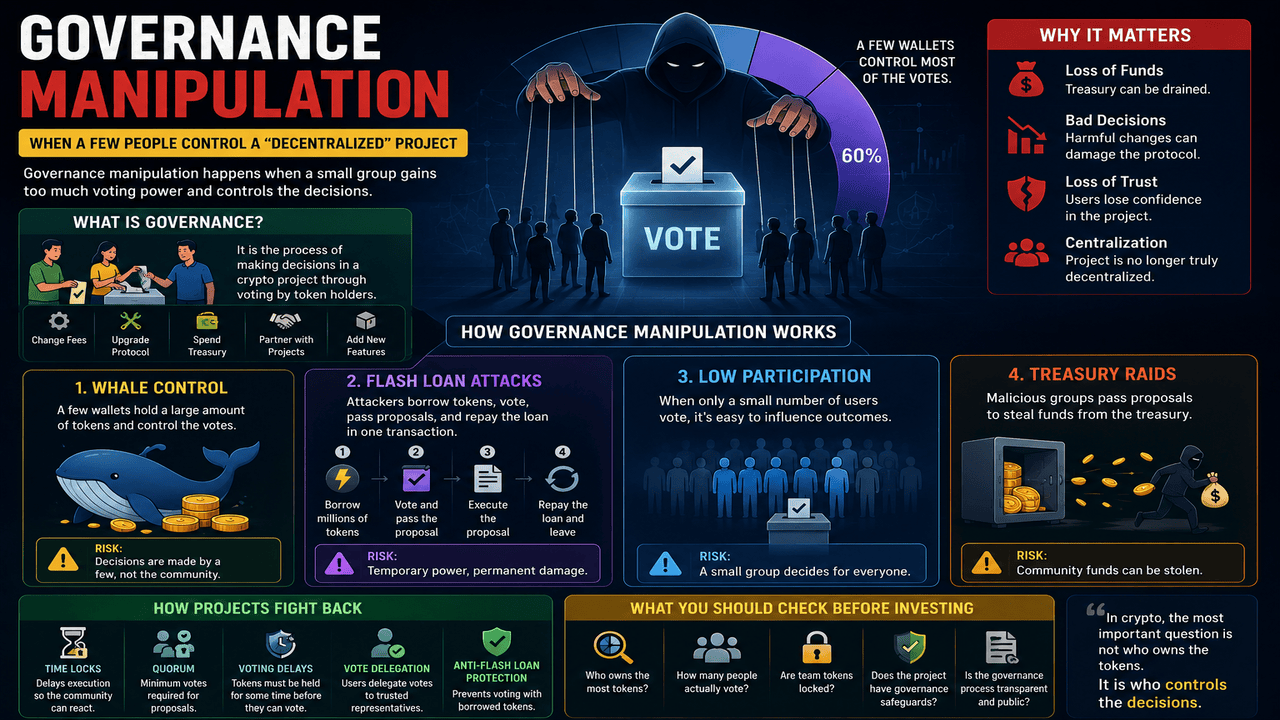
We call this manipulation of governance.
It is one of the most significant but little-discussed hazards in decentralized finance (DeFi).
The decision-making process in a cryptocurrency project is called governance.
These choices could consist of:
Token holders can vote in the majority of projects.
In general, a person's voting power increases with the number of tokens they possess.
This seems reasonable at first.
However, it may lead to issues.
Let's say your school lets students choose how much money to spend on school events.
One vote is given to each student.
That appears to be democratic.
Imagine now that a single student unexpectedly gets 500 more votes.
Would there still be a fair election?
Most likely not.
Everything might be decided by the student.
In terms of crypto governance, the same thing can occur.
Someone with a lot of tokens is called a whale.
A whale can have a significant impact on choices if they hold 30%, 40%, or even 50% of the voting supply.
The majority of voting power in some projects is controlled by a small number of wallets.
Although the initiative seems decentralized, a tiny group actually makes most of the choices.
One of the riskiest ways to manipulate governance is this.
Someone can borrow a significant sum of cryptocurrency for a brief period of time using a flash loan.
An assailant could:
The attacker does not truly possess the tokens in the long run, but they do have temporary control over the vote.
Very few people participate in many governance votes.
For instance:
This implies that results can be readily influenced by a small group.
Only a small portion of users may decide on a proposal that affects millions of dollars.
Large treasuries valued at millions of dollars are held by certain projects.
It is possible for a malevolent group to obtain sufficient voting power to approve proposals that transfer money from the Treasury to themselves.
One of the main concerns with DAO governance is this.
Decentralized Autonomous Organizations are referred to as DAOs.
A DAO is a community-run organization where voting, as opposed to conventional management, is used to make decisions.
DAOs are used in many DeFi projects.
Examples include:
DAOs are potent, yet they are not immune to manipulation.
Governance threats can influence entire ecosystems.
Potential effects include:
Treasury assets may be diverted.
Bad decisions can impair security.
Users may lose faith in the initiative.
A few insiders may govern a project that is advertised as decentralized.
Imagine a nation where laws are decided by popular vote.
Imagine now that a wealthy organization surreptitiously purchases enough votes to win every election.
Voting is still possible in theory.
However, true democracy has vanished.
In cryptocurrency, governance manipulation causes a similar issue.
Although there is a voting method in place, influential people may already have decided the results.
Prior to purchasing a governance token, inquire:
Governance may be at risk if a small number of wallets control a significant portion.
Low involvement facilitates manipulation.
Governance issues could arise from unlocked team allocations.
Abuse prevention measures are a common feature of good governance systems.
Several defenses are used in modern projects.
Proposals that are approved might not be implemented for days.
The community has time to respond as a result.
Votes can be assigned by users to reliable delegates.
Proposals must receive a minimum number of votes to be approved.
Tokens must be kept for a predetermined amount of time before voting in specific projects.
Temporary borrowing attacks are thus prevented.
One of the most significant blockchain technology initiatives is still governance.
The objective is straightforward:
Give local communities the authority to manage projects without centralized management.
However, many people are unaware of how difficult true decentralization is.
Making sure that voting power represents true community interests rather than those of a select few wealthy participants is the most difficult task.
Initiatives that address this issue could serve as the cornerstone of the upcoming wave of decentralized organizations.
Many decentralized projects carry a hidden risk: governance manipulation.
Even though a protocol claims to be community-owned, ownership and voting power are not always shared equally.
Look past marketing catchphrases before purchasing any governance token.
Inquire about the voting process, decision-making procedures, and the system's ability to withstand manipulation.
Because who owns the tokens is not the most crucial question in cryptocurrency.
It is in charge of making decisions.
(1)-1790417752.png)
-1788346309.png)