Crypto Market Analysis Today (Nov 5, 202...
2026-11-05

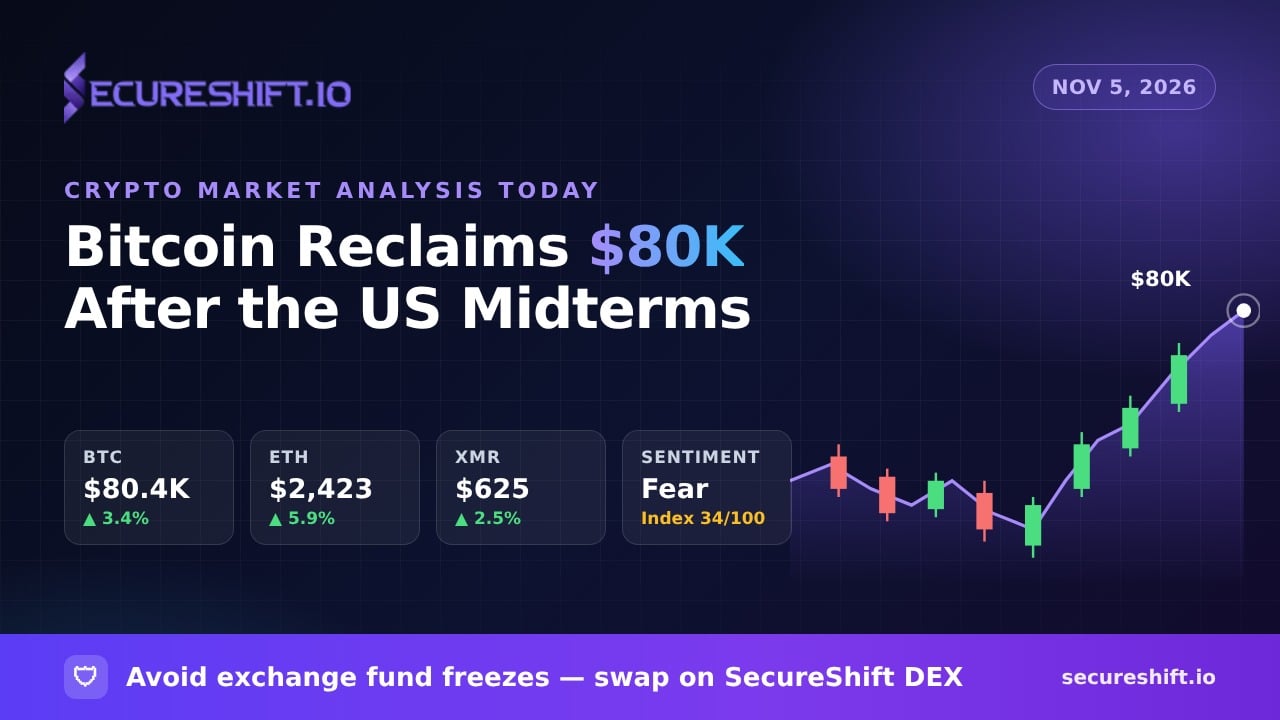
Crypto market analysis today (November 5, 2026): Bitcoin bounced back above $80,000 after the US midterm results came in. A short squeeze of roughly $380 million helped push it up. Ethereum gained almost 6% to retake $2,400, and Monero (XMR) held above $620 as privacy coins kept doing better than the rest of the market. Sentiment is still cautious, though. The Crypto Fear & Greed Index sits at 34 (Fear), and this week's $6.3 billion Binance breach, which froze withdrawals for days, reminded traders what custodial risk looks like. Below we cover the key levels for BTC, ETH, XMR, SOL and XRP. Then we explain why more traders are moving to SecureShift DEX so their funds don't get frozen on instant exchanges.
| Asset | Price (approx.) | 24h Change | Key Support | Key Resistance |
|---|---|---|---|---|
| Bitcoin (BTC) | $80,460 | +3.4% | $76,000 | $80,800 – $82,000 |
| Ethereum (ETH) | $2,423 | +5.9% | $2,280 / $2,170 | $2,500 |
| Monero (XMR) | $625 | +2.5% | $610 – $618 | $638.90 / $649.40 |
| Solana (SOL) | $95.40 | +2.1% | $91 – $92 | Broken trendline overhead |
| XRP | $1.26 | +0.5% | $1.24 / $1.197 | $1.27 – $1.29 |
Prices are approximate as of the morning of November 5, 2026 and move fast. Check live rates before you trade.
Bitcoin hit an intraday low near $75,600, its weakest level in months, before it reversed hard. The Democratic sweep in the US midterm elections settled a big political question. With a divided government now priced in, traders who had bought call options into election day were paid out. Over $378 million in BTC shorts were liquidated in a single hour, according to CoinGlass data, and that drove the move back above $80,000.
The rally still has to prove itself:
Levels to watch: A daily close above $80,800–$82,000 would open the way toward the mid-$80Ks. Losing $76,000 would put the multi-month lows back in play. BTC is still roughly 36% below its $126,080 all-time high.
Ethereum was the stronger of the two majors today. It rose about 5.9% to around $2,423, its first close above $2,400 in two weeks. Earlier this week ETH stalled under the $2,280 resistance with a daily RSI in the mid-30s. Today's move cleared that ceiling. $2,280 is now the first support, then $2,170. Bulls will want to see $2,500 flip to support to confirm a trend change.
Monero stays one of the strongest large caps. XMR trades around $625 after closing above the $609.90–$618.60 resistance cluster, which now acts as support. Its hashrate is near record levels, and privacy coins have held up well through the recent sell-offs. A daily close above $638.90 would put $649.40 and then $656.70 in focus. A drop back under $602 would weaken the setup.
Want exposure without opening an exchange account? You can swap BTC to XMR on SecureShift with no sign-up and no KYC.
Solana (SOL) bounced about 2% to around $95.40 from lows near $91–$92. A broken trendline still caps it overhead. XRP is stuck near $1.26 after slipping back under its $1.27 breakout zone. A daily close below $1.197 would undo its recent attempt to stabilize.
The Crypto Fear & Greed Index rose from 26 to 34. That is still in "Fear," and well below the roughly 70 reading of a month ago. A one-month low in the US dollar is helping risk assets. ETF outflows and exchange-security headlines are keeping big buyers cautious. The Federal Reserve's rate path remains the next big macro catalyst.
The biggest story under this week's price action is the $6.3 billion breach at Binance. The FBI attributed the theft to the North Korea-linked group TraderTraitor. Binance halted all deposits and withdrawals for about three days and only began a phased reopening on November 1. Even after that, Bitcoin and Ethereum withdrawals stayed partially suspended. As soon as withdrawals opened, users pulled out a net $3.6 billion in a single day.
Binance says it will absorb the losses and has covered most of the stolen assets. For several days, though, millions of users could not move their own coins while the market swung thousands of dollars. That is the main weakness of custodial platforms: when your funds sit in someone else's wallet, someone else decides when you can use them.
Centralized exchanges aren't the only problem. Many custodial "instant exchange" services work the same way. You send coins to their deposit address, and they send the swapped coins back from their own wallet. While they hold your funds, the swap can be stopped for reasons you can't control:
SecureShift is a non-custodial, no-KYC crypto swap platform. Its DEX routing lets you trade without handing your coins to a company account:
When exchanges are getting hacked, pausing withdrawals or tightening AML checks overnight, keeping custody of your own coins is the simplest way to protect them. Start a non-custodial swap on SecureShift DEX in under a minute.
Bitcoin rose about 3.4% to above $80,000 as the US midterm results removed political uncertainty. A short squeeze of over $378 million added to the move.
It reads 34 (Fear), up from 26 the day before but well below the "Greed" readings of a month ago.
Binance paused deposits and withdrawals after a $6.3 billion breach that the FBI attributed to North Korea-linked hackers. It started a phased reopening on November 1.
Keep your coins in a wallet you control, and swap through a non-custodial DEX such as SecureShift instead of depositing funds into a custodial exchange or instant-swap service.
Yes. SecureShift lets you swap crypto without registering or submitting KYC documents, and DEX swaps settle directly to your own wallet.
Disclaimer: This crypto market analysis is for informational purposes only and is not financial advice. Cryptocurrency prices are highly volatile. Always do your own research.