Bitcoin (BTC) Price Prediction 2026 - 20...
2026-09-26


The crypto market enters the back half of 2026 trying to shake off one of its coldest stretches in years. After a brutal first half, prices are stabilizing, dominance is consolidating around Bitcoin, and a regulatory storm over privacy coins is reshaping where and how people trade. Here is where things stand - and what to watch next.
The total crypto market capitalization is holding near $2.3 trillion as of early July 2026, down roughly 47% from the October 2025 peak. That drawdown officially qualifies as a bear market, but the tone on the ground is less grim than the number suggests. Analysts note that dedicated buyers have repeatedly stepped in on dips, keeping this crypto winter milder than the deep freezes of 2018 or 2022.
Bitcoin opened around $63,997 on July 7, up 0.7% on the day and posting back-to-back strong sessions. Ethereum opened near $1,798, up 0.8%, and is testing whether it can close the month above the psychologically important $1,800 level. Both assets logged their strongest monthly gains since May, and the calendar may be on their side: historically, whenever Bitcoin has had a "red" June, it has tended to rebound with a "green" July. June 2026 was, in fact, Bitcoin's worst month in four years, setting up the seasonal bounce traders are now watching closely.
The macro backdrop is doing much of the heavy lifting. Stronger-than-expected U.S. jobs data has lowered the odds of another Federal Reserve rate hike. That matters for crypto because a lower prospect of rate increases reduces the opportunity cost of holding non-yielding assets like Bitcoin and Ether. When cash and bonds look less attractive on a relative basis, risk assets, crypto included, tend to catch a bid.
Sentiment is also recovering off deeply pessimistic lows. Bear markets rarely end with fanfare; they end when forced sellers are exhausted and marginal buyers return. The repeated defense of support levels through the spring suggests that process may already be underway, even if a decisive new uptrend has yet to confirm.
Bitcoin dominance sits around 55.5%, meaning BTC alone accounts for more than half of all crypto value. That figure is arguably understated: with stablecoins now representing more than $300 billion of the total market, the "real" dominance of Bitcoin relative to volatile altcoins is higher still.
High dominance during a downturn is a classic risk-off signal. Capital consolidates into the perceived safest, most liquid asset and retreats from the long tail of speculative tokens. For altcoins, that means underperformance until risk appetite broadly returns, a rotation that typically arrives only after Bitcoin itself has stabilized and begun trending up.
The defining regulatory theme of 2026 is the tightening noose around privacy coins. Agencies and frameworks including MiCA in Europe, the SEC in the United States, and India's FIU have pushed exchanges to delist assets with "anonymity-enhancing" features in order to keep their operating licenses.
The effect on prices has been violent. Monero (XMR), the flagship privacy coin, spiked to around $799 in early January before aggressive profit-taking and delisting fears knocked it down sharply; it now trades near $331, with roughly $108 million in daily volume. Zcash (ZEC) and Dash (DASH) have seen their influence wane under the same pressure.
Yet Monero's underlying technology remains among the most robust in the sector. Ring signatures, stealth addresses, and RingCT confidential transactions give it a level of fungibility that transparent chains cannot match. A pending "Bulletproofs+" upgrade, expected in late 2026, aims to shrink transaction sizes and fees : potentially strengthening its practical case for legitimate uses like private remittances even as centralized venues back away.
As centralized exchanges shed privacy assets, two things are happening at once. First, capital is flowing from "black-box" privacy tokens into transparent, non-custodial platforms particularly perpetual DEX tokens that offer centralized-style leverage without FTX-style custody risk. Second, the very act of delisting XMR from major CEXs pushes privacy-conscious traders toward decentralized venues that will still support it.
The DEX sector is more than large enough to absorb that migration. Uniswap alone processed over 915 million swaps and more than $1 trillion in volume during 2025, and the broader decentralized-exchange category commands a market cap in the tens of billions. Non-custodial trading, where users keep their own keys and settle peer-to-peer, is increasingly the default answer for anyone whose preferred assets no longer clear regulatory hurdles on centralized platforms.
The following is an editorial note on one option in this shifting landscape.
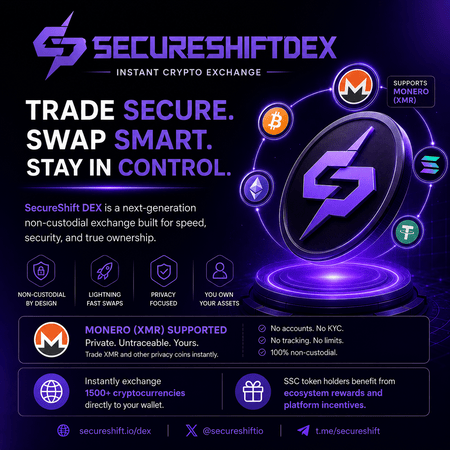
For traders affected by exchange delistings, SecureShift is a decentralized, cross-chain exchange that continues to list Monero (XMR) as a live network. It runs on a non-custodial, no-registration model : no account, no KYC, not even an email, so users never surrender their keys or route funds through a centralized intermediary. Those are exactly the properties that matter most when a privacy asset is being squeezed out of mainstream venues.
Mechanically, SecureShift works as a cross-chain swap: you pick a pair, enter an amount, and paste the recipient wallet address, and the swapped tokens are delivered on-chain the platform advertises settlement in roughly 15 seconds and routes orders across multiple DEX liquidity pools for better execution. Monero is supported both ways, with direct pairs such as BTC↔XMR, ETH→XMR, and XMR→SOL. The site reports $2.4B+ in total volume, 1,300+ token pairs, and a headline swap fee around 0.1% (tiered by pool: ~0.05% stable, 0.30% standard, up to 1% exotic). Its "No Hostage" AML-before-swap design is meant to ensure funds are screened up front rather than frozen mid-transaction, and failed swaps are auto-refunded to the origin wallet.
The value proposition is straightforward: as CEX access to Monero narrows, cross-chain DEXs like SecureShift preserve on-ramps and off-ramps for a coin whose core appeal is fungibility and self-custody. As with any DEX, users should still apply standard diligence, verify the official URL, understand slippage and liquidity for XMR pairs, double-check the recipient address, and confirm that using privacy assets is permitted in their jurisdiction. Regulatory treatment of privacy coins varies widely by country, and compliance remains the user's responsibility.
July 2026 is a market catching its breath: a seasonal rebound in the majors, Bitcoin dominance signaling caution, and a macro tailwind from a Fed that looks less likely to hike. The deeper narrative, though, is structural. The regulatory war on privacy coins is redrawing the map of where trading happens, accelerating the shift from custodial exchanges to non-custodial DEXs. Whether that shift ultimately strengthens crypto's resilience or simply fragments its liquidity is the question that will define the rest of the year.
This article is for informational purposes only and is not financial advice. Cryptocurrency is volatile and regulatory conditions vary by jurisdiction; do your own research before trading.
(1)-1790417752.png)

-1788346309.png)